THE RECORD
GameLit Origins
In September 2017, a small group of authors gave a name to a kind of story that had been growing without one. The name was GameLit — and SciFan Magazine, this site's own ancestor, was there at its beginning: one of the word's four coiners was the magazine's publisher, and the magazine's tenth issue became the new genre's special edition. This page gathers what the record shows — the definition the founders agreed upon, the charter that still stands, and the evidence, preserved in the Internet Archive, that backs every word of it.
A Name for Stories that Play
By 2017, a generation of novels had grown up around games — stories where rules, levels and mechanics are not decoration but the engine of the plot. The shelf had one famous label, LitRPG, and it fit only some of them. The wider family needed a wider word.
On September 4, 2017, that word emerged in a conversation in LitRPG Rebels, the Facebook group run by Zachariah Dracoulis, among four authors: Zachariah Dracoulis, R. M. Mulder, Dustin Tigner, and John Ward. The word: GameLit.
GameLit: A story with gaming elements essential to the plot. Often includes features of Science Fiction, Fantasy, or Science Fantasy. While all LitRPG books fit within GameLit, not all GameLit books fit within LitRPG. This is an open genre. There are no official groups, gatekeepers, or rule-makers.
gamelit.org — Live Within Weeks, Unchanged for Years
The definition did not stay in a chat thread. A home was built at gamelit.org — by Tigner's own account he grabbed the domain himself, before the definition was even put to a vote.
The Internet Archive's first capture: September 22, 2017 — 18 days after the coining — already carries the complete charter (the definition, the Science Fiction / Fantasy / Science Fantasy line, the LitRPG sentence, and the open-genre declaration), exactly as quoted above.
The homepage stayed byte-for-byte identical in archive captures from September 2017 through June 2019, and the definition still stands word for word in the most recent capture, July 12, 2026 — nearly nine years on. Tigner has looked after the site throughout; the current page points readers to him.
Four authors coined a word in a Facebook thread. The page they built for it has now outlasted almost everything else from that autumn — unchanged.
A Month of Debate, Then No Gatekeepers
The founders opened the discussion; it grew into a private working group — the GameLit Council — of more than two dozen authors. For a month, through what Tigner describes as thousands of messages, the Council debated a single shared definition and a plan to launch the genre.
“It took a month of all-day-long debates with over two dozen authors to come to this definition back then, September 2017.”
The definition the Council produced is the one on gamelit.org. The launch plan paired the website with a magazine special edition. That magazine was SciFan.
The Council's own working channel survives as evidence of its own: a Slack workspace opened on September 8, 2017 — four days after the coining — where the debate and the launch planning happened. That workspace still exists today, its roster intact.
SciFan Magazine and the Special Edition
SciFan Magazine published ten monthly issues through 2017 — Issues 1–10, January to October — alongside special editions including April and May 2017 LitRPG editions. Publisher: R. M. Mulder. The magazine's Co-Producer was Dayne Edmondson — Mulder's partner in producing SciFan Magazine, and co-owner of its collections.
On September 11, 2017 — one week after the coining — the magazine's website carried Jared J. Fleming's story post Casus Belli – Part 1, tagged, for the first time anywhere on the site, #GameLit. An archive capture of the front page preserves that tag.
Issue 10 — Beyond Science Fiction & Fantasy, 206 pages, cover-dated October 2017 — was the magazine's GameLit edition. Announced September 23, 2017 by Mulder (designed to pay special tribute to the oppressions they have faced, and the strengths these authors possess); published in the last week of September 2017; the magazine's release post September 29, 2017 billed it as our special #GameLit Edition.
Issue 10 at a glance
- TITLE
- SciFan Magazine Issue 10 — Beyond Science Fiction & Fantasy
- COVER DATE
- October 2017
- PUBLISHED
- September 26, 2017
- LENGTH
- 206 pages
- ANNOUNCED
- September 23, 2017
- RELEASE POST
- September 29, 2017
- CREDITS
- Publisher: R. M. Mulder · Co-Producer: Dayne Edmondson
The Last Issue
In August 2017, the publisher announced openly in the magazine's community that the April and May LitRPG special editions were being withdrawn (they had not performed).
The GameLit launch, when it came, unraveled from inside. On September 19, 2017, the magazine's planned launch announcement was called off by SciFan's own editors. Issue 10 was published in the last week of September — and on its release night, September 30, the editors briefly withdrew the issue themselves; it was back on sale by October 14. No outside hand took it down. The Council that had spent a month building the genre's definition disbanded in the aftermath, leaving GameLit — in the spirit of its own charter — with no official group to represent it, free to grow or fail on its own. And after Issue 10, SciFan Magazine published no more. There was no Issue 11.
The magazine's website went dark; much of its archive disappeared. Whole posts survive only because the Wayback Machine copied them first. Some pieces were never copied: the magazine's own index of its issues is gone; Issue 10's story texts live on only in surviving print/digital copies.
The SciFan archive is being rebuilt now, post by post, from Wayback captures — each recovered article backdated to its original day and footnoted as restored — on the magazine's WordPress home.
A Word, and the Group That Took Its Name
Two of the men in this story were connected long before GameLit had a name. Blaise Corvin, whose LitRPG Society was then the genre's largest Facebook community, had introduced Mulder to Ramon Mejia, host of the LitRPG Podcast — the community's review voice. SciFan Magazine had promoted Mejia's podcast, free, in its pages. It was Corvin's introduced reviewer who received the advance copy of Mulder's rewritten Conquest in May 2017 — and the review that followed scored it 2 out of 10 and declared it 'not LitRPG.'
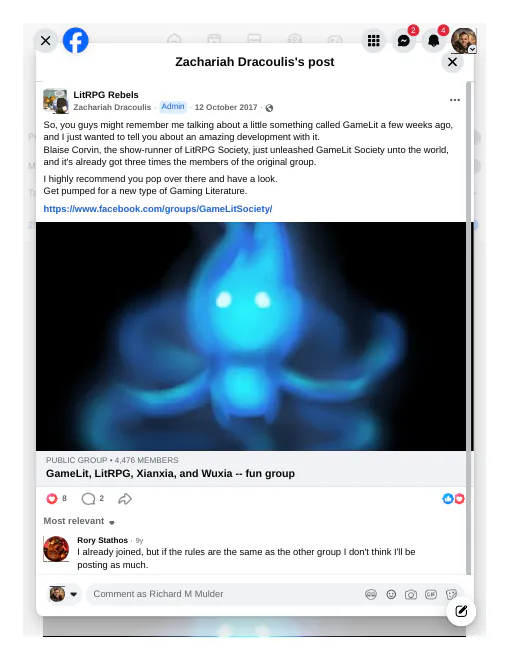
When the four authors coined GameLit that September, no group founded it — four authors did, in a conversation. The Facebook group called GameLit Society, Corvin's, launched on October 12, 2017, five weeks after the coining, adopting a name that already existed. Announcing it, one of the four founders — Zachariah Dracoulis — referred to 'a little something called GameLit a few weeks ago.' The Society became a community that carried the name. It was not the founder of GameLit.
Corvin's own later account, published on his website in December 2018, cast his role differently: he wrote that the term had gotten no traction at all before he got involved, and that once he adopted it and threw the groups he had cultivated behind it, it 'got some movement.' That is the record of a man who popularized a word — a community carrying a name far and wide. The name itself was already five weeks old, coined by four other authors, before his group took it up.
In that same account, Corvin also wrote that nobody was quite sure who exactly coined the term — and an undated edit to the post later named a single coiner, "Justin Tigner" [sic], getting even his first name wrong. By the time Corvin wrote, the founders had been a matter of public record for a year: in December 2017, Tigner had confirmed that the coining was "just the four of us." And Corvin had heard of the Council from one of its own members within days of the coining — as the next section shows.
The Member on Both Sides
One member of the Council stood on both sides of this story. Dawn Chapman, a SciFan contributor, was part of the original GameLit Council — her name stands on the Council's Slack roster to this day — though she asked not to be named in the founders' public lists, and Tigner left her off them at her request. It was Mulder himself who had introduced her to Blaise Corvin.
While the Council planned in private, Chapman was also working as a moderator in Corvin's groups. On September 16, 2017, she told Mulder that she had told Corvin she had been invited to join the Council. On the night GameLit Society launched — October 12, 2017 — it was Chapman who cautioned Mulder, inside the new group, that many there were still bitter about SciFan. She defriended both editors in the Issue 10 weekend's aftermath. And that December, when Mulder sought to rejoin the community's groups, it was Chapman who carried back the moderators' answer: none of them would accept him back in — herself included.
Her messages of December 17, 2017 went further still. She told Mulder he had been "removed by Blaise the first and second times" — a claim he disputed on the spot; his own record shows a voluntary exit from some twenty-three groups in the first week of October, and no Society removal appears in the membership log. She said she would put his readmission to a vote of the moderators. That afternoon she reported the result — "sorry Richard, the answer is no, everyone says it" — and the conversation ended there.
Every junction of the controversy ran through the same person: the introduction, the confidence, the warning, and the closed door.
Why the Word Went Nowhere
Corvin's history explains the word's slow start simply: nobody involved, he wrote, had "the platform or experience necessary to get it off the ground." The record shows what happened to the platform that existed.
In August 2017, SciFan withdrew its April and May LitRPG special editions — a step Mulder told Chapman at the time was primarily Corvin's decision: Corvin had refused to sign the contract, and said he would prefer the editions taken down. On September 30, 2017, the release night of Issue 10 — the magazine's last — a warning reached the editors that if any of the big groups picked up on the issue's GameLit article, they would have "a virtual mob" at their doorstep. The issue was pulled within hours; it returned two weeks later, but the magazine never published again. Mulder has always read that warning as a veiled threat: the man who delivered it, he believed, moderated for one of Corvin's groups. And in December 2017, when Mulder sought to rejoin the community's groups, the moderators of Corvin's groups voted on it — and voted no (see the previous section).
Nor was Corvin's the only gate of that season. In the spring of 2017, Aleron Kong, whose LitRPG group was the genre's other center of power, had banned SciFan Magazine's promotion from his group, banned Mulder personally days later, and by June had banned Mulder's pen-name account as well. Mulder was not the only author shown that door: Tigner's published history of GameLit (2022) records that Kong banned many authors from his LitRPG Facebook group, and misused his moderator privileges on the genre's subreddit besides.
Corvin himself had publicly condemned Kong's other gate. In his December 2018 history, he recorded that Kong had twice attempted to trademark the word "LitRPG" itself, that several authors had been worried by the attempts — himself among them — and that he had grown tired of the entire mess before stepping aside from it into GameLit. His word for the episode was "fiasco."
The record thus documents both gates of that season: Kong's, which Corvin had criticized in public, and Corvin's own, where in December 2017 his moderators voted one of the genre's founders out of the community.
Mulder's own conclusion, stated as his: the word did not fail for want of a platform. Its founders were shut out of the rooms where it would have spread — the magazine pressured into silence, and its editor voted out of the community's largest groups.
See It in the Archive
Every document below exists. Each screenshot was taken from the Internet Archive's Wayback Machine; each link opens the archived page itself.
Exhibit 1 — The charter, eighteen days after the coining
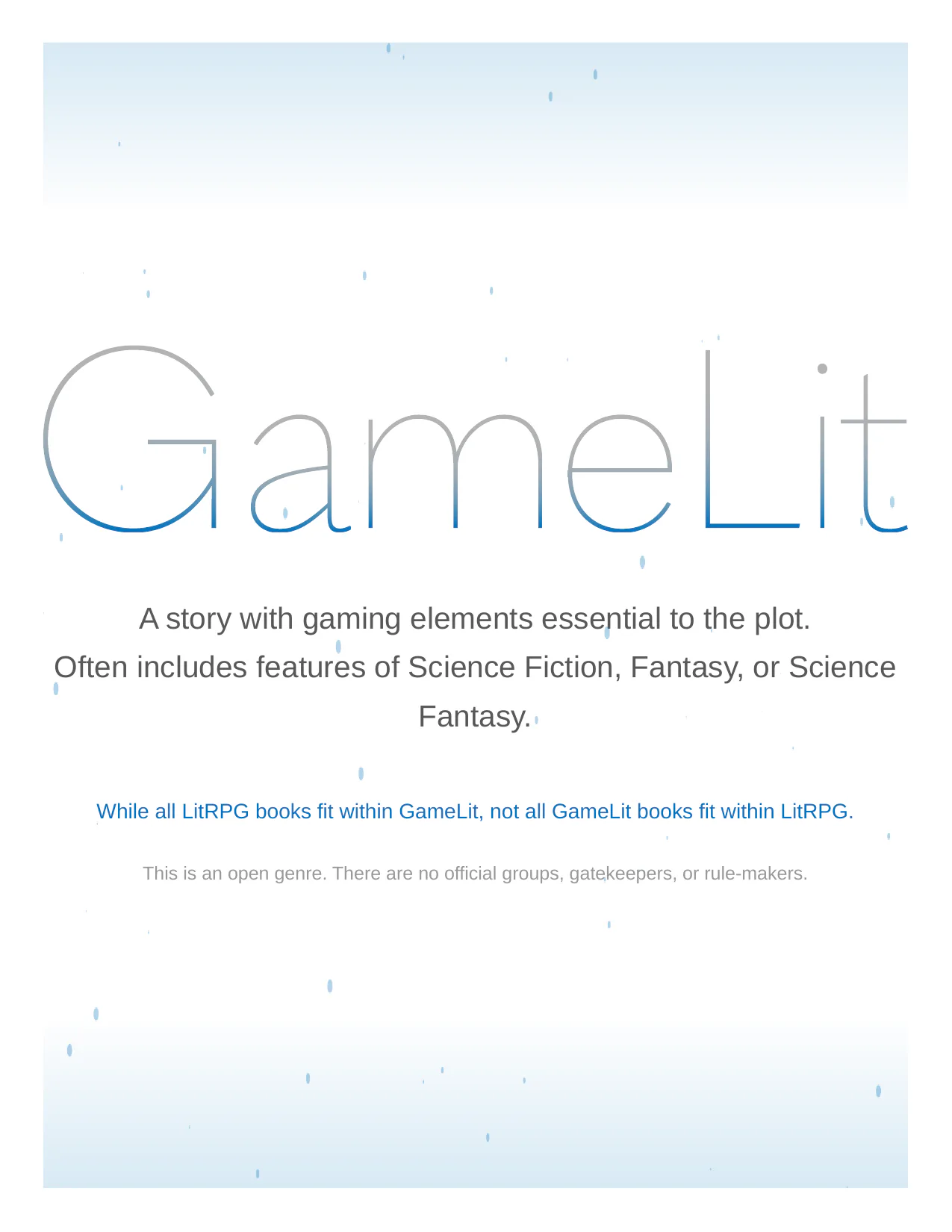
gamelit.org as the Wayback Machine first recorded it, September 22, 2017 — the complete GameLit definition and charter, already live.
Exhibit 2 — The founder's account
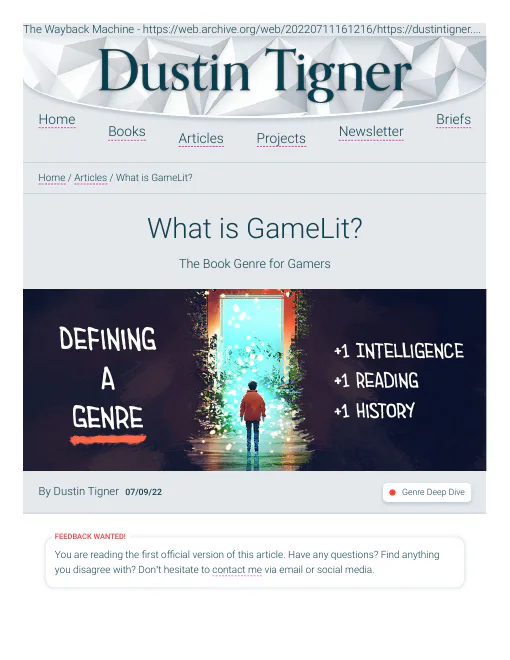
Dustin Tigner's first-person history, What is GameLit? — the LitRPG Rebels thread, the Council, and the month of debate, in a founder's own words. First archived July 11, 2022; the history stood unrevised in the archive through 2024.
Exhibit 3 — The definition, still standing

gamelit.org as captured on July 12, 2026 — the 2017 definition, verbatim, nearly nine years later. The page also points readers to Tigner's article (Exhibit 2).
Exhibit 4 — The magazine's front page, release week
A Wayback capture of SciFan Magazine's homepage, October 6, 2017 — the post list carries Casus Belli – Part 1 #GameLit, the word's first appearance on the magazine's own site (the story was posted September 11, 2017).
No screenshot filed; the archived page itself is the exhibit.
Exhibit 5 — The restored archive
Recovered pages restored to the magazine's WordPress home.
SciFan Magazine's Quarterly LitRPG-Exclusive Editions (2016–2017 archive page)The magazine's Booklist (2016–2017 archive page)The Issue 10 announcement — SciFan™Con 2017 is Happening Next Weekend! (restored, September 23, 2017)
Exhibit 6 — The founding-week letters, complete
The whole exchange, preserved in Mulder's own mail archive and exhibited in full. It begins in May 2017, with Mulder's published essay defending Conquest as LitRPG — the essay that points readers to the LitRPG Forum's long-running "What's a good definition of LitRPG?" thread, where the genre's boundaries had been argued for months. The letters resume on the evening of September 4, 2017 — the day of the coining — and run through September 6. In Dustin Tigner's reply of September 5, 2017, the new word appears in a founder's hand, already a banner: he names the LitRPG Podcast's narrow definition as part of what was pushing him and GameLit, and closes with a call to push forward and remove the gate keepers. It is the earliest dated writing yet recovered in which one of the four coiners uses the word — proof on paper that GameLit existed the day after the conversation that coined it.
Read the full exchange: /founding-letters.html
(The letters are private documents, shown complete and as preserved, with Mulder's permission. No Wayback capture of them exists — none could.)
A note on what the archive can and cannot show
The founding conversation was inside a Facebook group; the Wayback Machine cannot see inside Facebook — no capture of that thread exists. The coining's date and its four participants rest on the founders' own records — and those records speak directly: in December 2017, Tigner confirmed to Mulder that the coining was 'just the four of us,' and the Council's own join dates begin on September 4 itself. Tigner's letter of September 5, 2017 (Exhibit 6) shows the word already in a founder's hand the day after the coining, in an exchange that survives complete in Mulder's own mail archive. Tigner's published account corroborates every particular the archive can check — the venue, the participants, the month. Everything else (the definition, the charter site's dates, the magazine's posts and special edition) is independently preserved in the archive at the links above.
The Word Outlived the Magazine
GameLit's story did not end with Issue 10. The group that took the name endured in its own right: GameLit Society, created new that October while the older LitRPG Society continued under a new name — RPG GameLit Society — remains an active community today. 2018: GameLit Expansion Pack (#GameLitXP) anthology — stories by Brian D. Anderson, Stan Faryna, Patrick Hodges, Dimitri G. Knight, R. M. Mulder, A. E. Scully, Anthea Sharp, Terry Spider, and James Wymore, organized by Mulder. In an October interview Mulder recorded that it held the #1 Bestseller spot in its Virtual Reality category for five weeks; its pages carried the debut of his DarkForce sequel.
Reader resource: GameLit Insider, a website and social feed devoted to finding the hottest new stories trending in the popular new genre known as #GameLit, a free resource for readers.
The charter page never went away — the definition still stands at gamelit.org today, the same words, open genre, no gatekeepers.
In January 2027 SciFan marks ten years since the magazine's first issue — the archive, the stories and the name it helped launch are all in print again.
Celebrating 10 Years of SciFan… And Beyond?
A Personal Note
What followed was a very dark time for me. I tried once more, with the GameLit Expansion Pack anthology, and it failed — primarily, I believe, due to the shadowban. Over the years that followed, I rewrote my story into three books. The manuscript of the fourth is finished; it has gathered dust for years, through depression. The fifth — the capstone — remains in draft.
— R. M. Mulder